
What a Lucky Sweater Can Teach Us About Entrepreneurship
What a Lucky Sweater Can Teach Us About Entrepreneurship
“Can we have them do the sweater activity?”
I was on a call with my friend Susan Crosier, head of school at Grace Preparatory Academy in Texas, discussing the upcoming professional development we were planning for her entire faculty and staff.
As I walked through the agenda and shared a few ideas, Susan asked if we could use one of the activities from the entrepreneurship educator training I host every June.
“People love the sweater activity!”
The more I thought about it, the more it made sense. Of course we could do the sweater activity. What better way to introduce people, head-on, to the entrepreneurial mindset than to have them dive straight into prototyping and building a minimum viable product?
The sweater activity is one of the flagship activities from the entrepreneurship curriculum I use with schools around the world.
We begin by establishing the problem—and remember, the goal is to fall in love with the problem, not the solution.
In this instance, the problem is my dear Aunt Marsha, whose crippling arthritis in her hands makes it nearly impossible for her to button her favorite sweater.
And why is this such a big deal?
Because her favorite sweater is also her “lucky sweater,” and heaven forbid anyone keep Aunt Marsha from wearing her lucky sweater.
Thus, the opportunity: Can we create, in a limited amount of time and with a limited number of supplies, a prototype of a tool that can help Marsha button her sweater?
With that challenge and a few clear constraints, the activity begins.
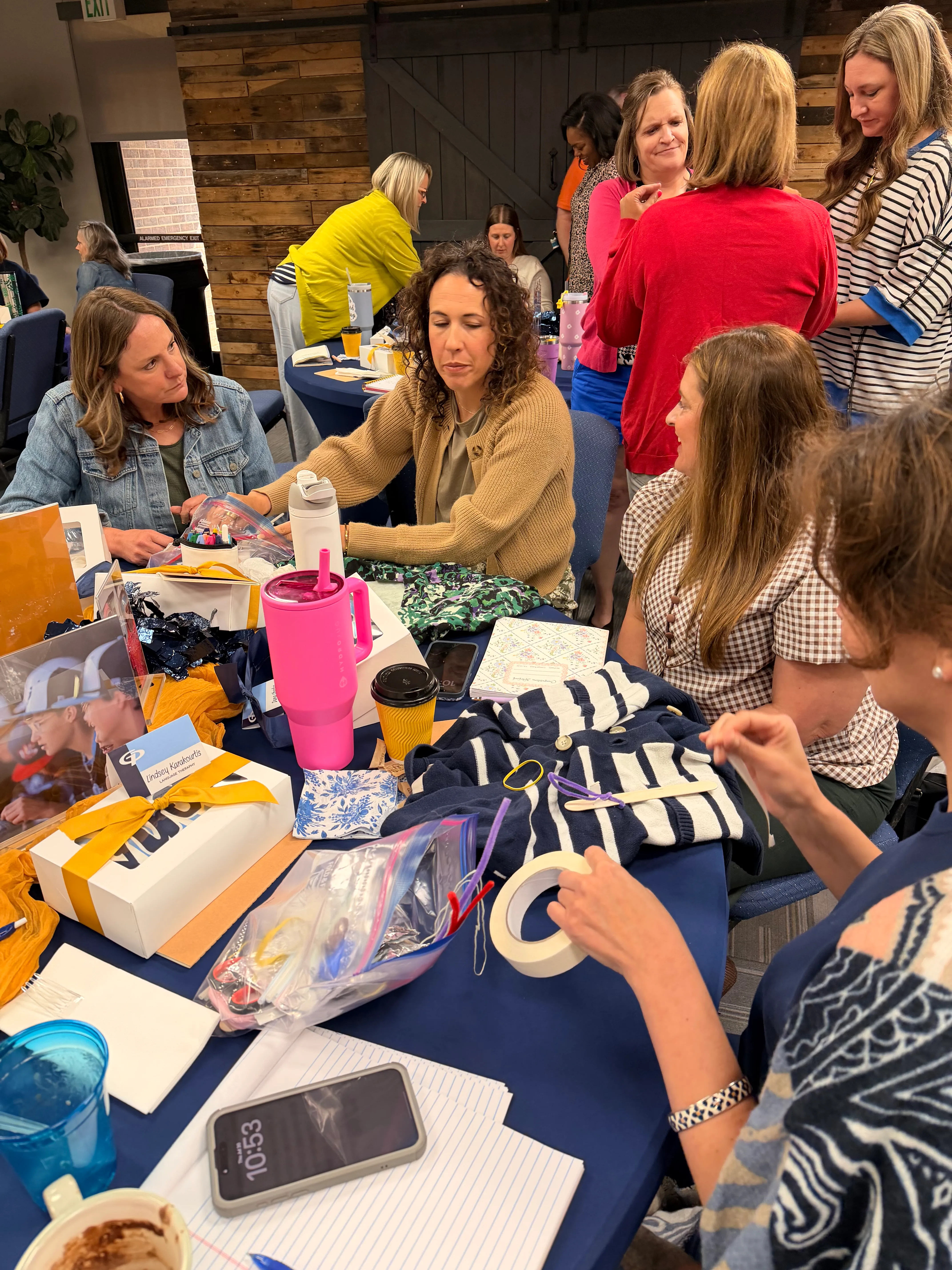
Groups of three or four leap into action. They grab sample sweaters and begin working with pipe cleaners, cardboard, rubber bands, paper clips, tape, and other basic supplies. Their goal is to create a working prototype that will allow Marsha to function as normally and independently as possible despite her condition.
Soon, time is up, and the groups have to move from building to marketing.
What will they call their product? Who is their ideal customer? What sets their tool apart? How will they market and sell it?
Then the real fun begins. Group after group gets up and “sells” its product to the crowd.
While the activity itself is a great way to introduce design thinking and the entrepreneurial mindset, the greater benefit comes from two powerful takeaways: the need for empathy and the beauty of collaboration.
As we identify with Marsha—often by attempting to model what it might feel like to have crippling arthritis in our own hands—we begin to see the world through someone else’s experience.
And as we work on a team, we make another remarkable discovery: Other people exist, and they may even have some pretty good ideas.
It took very little convincing for Susan to talk me into doing the activity with all 80 members of her team.
Although this required her team to make a last-minute trip to the thrift store—and finding sweaters in July in Dallas, Texas, is an interesting mission—it all worked out in the end.
Teaching entrepreneurship through an elective course is great.
But teaching the entrepreneurial mindset to your entire faculty and staff is a game changer.
When educators themselves understand empathy, collaboration, design thinking, prototyping, and the willingness to test an imperfect idea, those principles begin to shape far more than a single classroom. They begin to shape the culture of the entire school.
It’s going to be a great year for Grace Prep.
If your school is interested in exploring what it could look like to develop the entrepreneurial mindset across your faculty and staff, I’d love to connect.